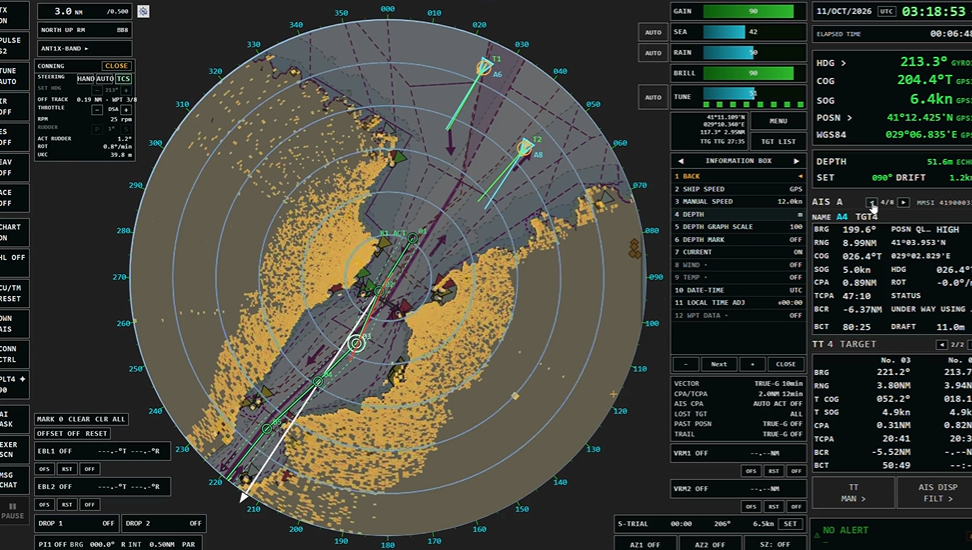
Fully functional Radar and ARPA simulator. Detect and track targets with high accuracy, compute CPA/TCPA for every vessel, and practice collision avoidance decisions in all weather and visibility conditions.
A walkthrough of target acquisition, CPA/TCPA tracking, all-weather conditions, and AI-driven fault injection inside the simulator.
NavXSim's Radar/ARPA simulator replicates ship's radar with full ARPA functionality. Trainees practice target acquisition, tracking, CPA and TCPA computation, and correct collision avoiding action per COLREG rules โ in fog, rain, sea clutter, and night conditions. Integrated with Bridge Simulation for full multi-equipment training.
Detect and track up to 40 simultaneous ARPA targets. CPA and TCPA computed in real time for each vessel.
Train in rain clutter, sea clutter, fog, and night conditions. Gain, sea clutter, and rain clutter controls fully functional.
CPA below 1.0 NM triggers collision warning. Practice correct avoiding action per COLREG Rules 8, 16, and 17.
Every radar decision logged. Correct and incorrect avoiding actions scored. AI debrief generated post-session.
ARPA ON ยท CPA/TCPA alerts ยท All-weather radar simulation

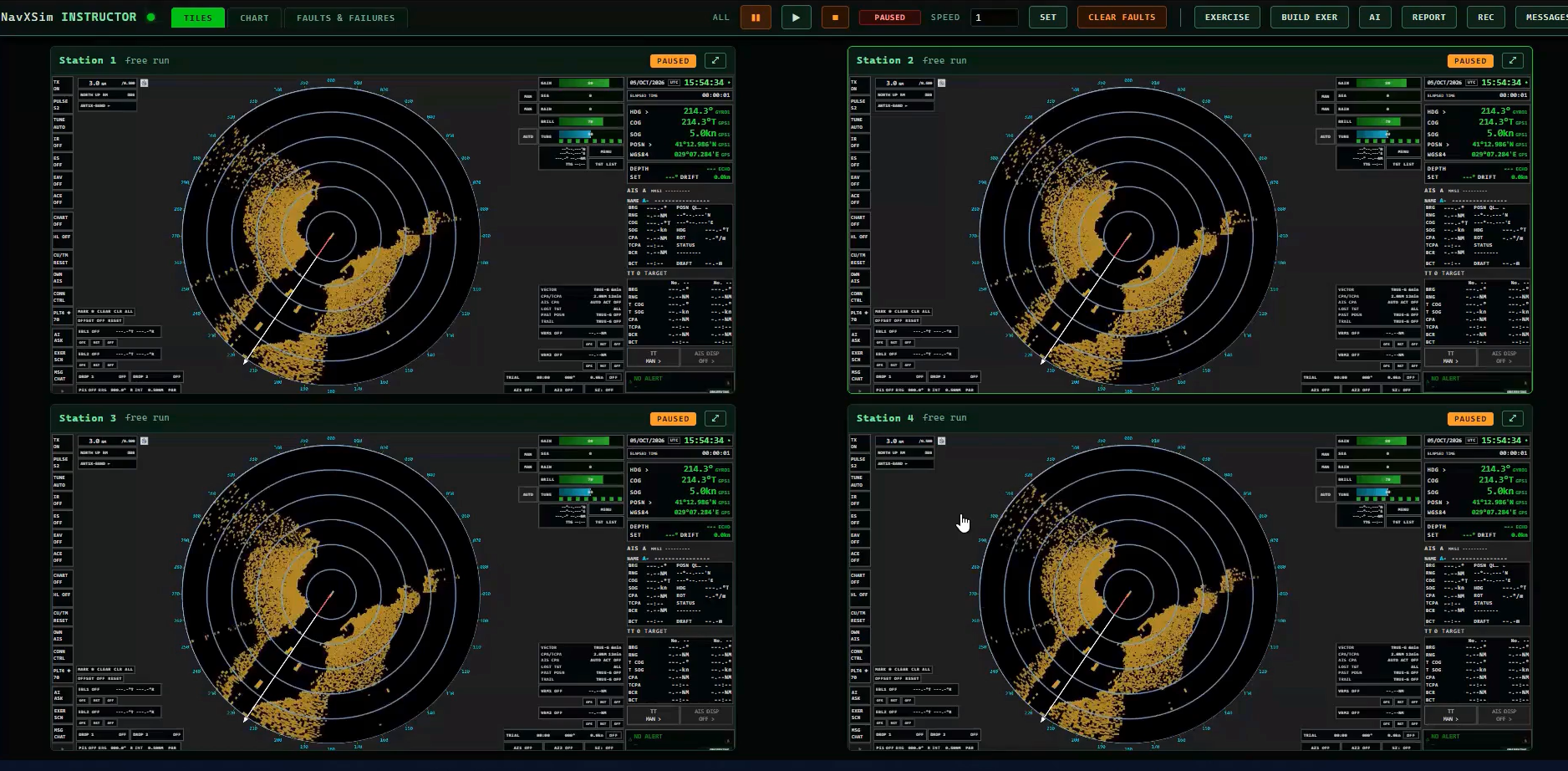
A centralized instructor console provides real-time monitoring of all trainee radar stations from a single screen. Instructors can view each trainee's radar picture, exercise status, targets, alarms, and equipment condition, with one-click full-screen access to any station.
The console enables instructors to pause/resume individual stations or the entire class, configure environmental conditions, and inject realistic radar, ARPA, navigation, and sensor faults during an exercise. Faults can be triggered manually or scheduled against the exercise timeline, allowing different trainees to experience different scenarios.
A powerful tactical chart provides instructors with a real-time view of the exercise area, including own ship, target vessels, AIS contacts, and planned traffic routes. Instructors can create, edit, assign, and control vessel routes directly on the chart, with support for single-run, shuttle, and reverse movements.
Vessels can be positioned, renamed, and dynamically controlled for speed, heading, and course, while targeted faults such as AIS failures, SART events, false echoes, and other scenarios can be applied to individual contacts.
The exercise environment can be saved and deployed to all trainee stations simultaneously, including vessels, routes, environmental conditions, timed faults, briefing instructions, and scoring objectives.
The NavXSim Radar & ARPA Simulator is engineered against Section A-I/12 of the STCW Code — the standards governing the use of simulators — and covers the radar and ARPA competences of Tables A-II/1, A-II/2 and A-II/3. Its exercises, controls and assessment criteria are aligned to the syllabi of IMO Model Course 1.07 and 1.08, so a centre can run both courses on it as delivered.
Suitable for the selected objectives; realistic shipboard behaviour including the equipment’s limitations and errors; a controlled environment able to produce emergency and unusual situations; and full instructor control, monitoring and recording for effective debriefing.
The same realism applied to assessment: defined assessment objectives, a controlled environment, and an assessor able to control, monitor and record each candidate’s performance for objective evaluation.
Stabilised relative motion with sea- and ground-stabilised true motion; modelled weather, tidal streams, current, shadow sectors, spurious echoes and propagation effects; generated coastlines, buoyage and SART returns; a real-time environment with multiple own-ship stations and at least 20 target ships.
Manual and automatic target acquisition, past track information, exclusion areas, vector and graphic time-scale with full target data display, and trial manoeuvres.
Briefing and familiarisation, exercise monitoring with audio and visual observation, structured debriefing, and explicit, repeatable performance criteria that keep subjective judgement to a minimum.
Radar and ARPA competences for the Officer of the Watch, for Master and Chief Mate, and for vessels under 500 GT — mapped item by item to exercises, controls and assessment criteria in the simulator.
Aligned to Radar Navigation, Radar Plotting and Use of ARPA at operational level (1.07) and Radar, ARPA, Bridge Teamwork and Search and Rescue at management level (1.08) — from first set-up and plotting through target acquisition, trial manoeuvre and the limitations of the equipment.
| STCW reference | Category verified |
|---|---|
| A-I/12 §1 | General simulator performance standards — training |
| A-I/12 §2 | General simulator performance standards — assessment of competence |
| A-I/12 §4 | Radar simulation — mandatory facilities |
| A-I/12 §5 | ARPA simulation — mandatory facilities |
| A-I/12 §7 | Training procedures — briefing, familiarisation, monitoring, debriefing |
| A-I/12 §8 | Assessment procedures — explicit criteria, reliability and uniformity |
| Table A-II/1 | Officer of the Watch — use of radar and ARPA to maintain safety of navigation |
| Table A-II/2 | Master and Chief Mate — radar and ARPA competences |
| Table A-II/3 | Officers on vessels of less than 500 GT |
| Syllabus | Radar observation and plotting — setting up, measurement, plotting, misleading information |
| Syllabus | ARPA operational use — acquisition, vectors, trial manoeuvre, alarms, limitations |
| Model Course 1.07 | Radar Navigation, Radar Plotting and Use of ARPA — operational level |
| Model Course 1.08 | Radar, ARPA, Bridge Teamwork and Search and Rescue — management level |
| A-I/12 §1.2 | GPS spoofing and position-source error — EPFS failure, offset and false fixes, so a position is never trusted blindly |
| Table A-II/1 | AIS ghosting and misleading information — reported targets that are not there, and echoes with no AIS behind them |
| A-I/12 §1.4 | Ice navigation — bergs, bergy bits and growlers as radar contacts in a hazardous environment |
Select traffic density, visibility, weather, and sea state. Set CPA alarm thresholds matching real vessel parameters.
Trainee acquires targets, monitors CPA/TCPA, identifies collision risks, and takes correct avoiding action per COLREGs.
All decisions reviewed against COLREG requirements. Incorrect actions explained. Competency certificate generated.
Book a demo and see how NavXSim delivers ARPA certification faster and at lower cost.
info@navXSims.com | www.navXSims.com | www.nextdrona.com